Choosing the right pair of shoes is not only about style, color, or price. For people who experience foot discomfort, spend long hours standing, have sensitive feet, or need additional support, footwear can make a significant difference in everyday comfort.
This is where medicated shoes can become an option worth considering.
Medicated shoes are generally designed with comfort-oriented and supportive features such as cushioning, wider toe boxes, supportive footbeds, adjustable closures, and sometimes removable insoles. However, the term “medicated” can mean different things depending on the brand and product.
That is why buying the right pair requires more than simply searching for a shoe labeled “medicated.”
You need to consider your foot shape, size, activity, comfort requirements, shoe construction, and any specific foot condition you may have.
In this complete guide, we will explain how to choose medicated shoes step by step, which features matter most, how to check the fit, what mistakes to avoid, and how to select footwear for different everyday situations.
What Are Medicated Shoes?
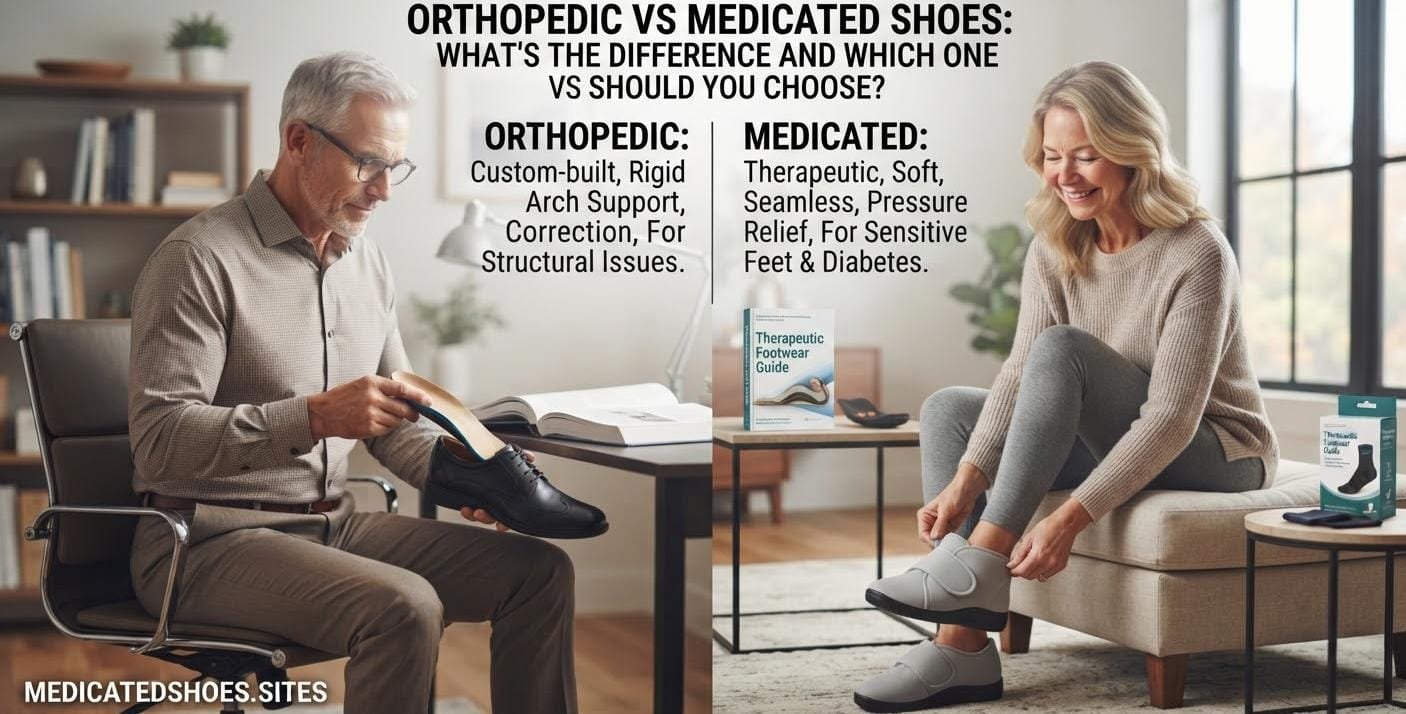
Medicated shoes are commonly marketed as footwear designed to provide enhanced comfort, support, cushioning, or protection compared with conventional shoes.
Depending on the design, they may include:
- 👣 Supportive footbeds
- 🛋️ Extra cushioning
- 🦶 Arch support
- ↔️ Wider toe boxes
- 📏 Extra-depth construction
- 🧩 Removable insoles
- 🛡️ Stable soles
- 🔄 Adjustable closures
- 🌬️ Breathable materials
- 🎯 Pressure-conscious designs
Not every medicated shoe contains all of these features.
The important thing is to evaluate the actual product rather than relying only on the name.
Why Choosing the Right Medicated Shoes Matters
A poorly fitting shoe can create discomfort even if it is marketed as a premium or orthopedic product.
A good shoe should work with your feet rather than force your feet into an uncomfortable position.
The Right Shoe Should Ideally:
- Fit your foot shape
- Provide adequate toe room
- Hold the heel securely
- Offer suitable cushioning
- Provide appropriate support
- Allow comfortable movement
- Match your daily activity
A shoe that feels comfortable for a few minutes should also remain reasonably comfortable during your normal use.
Step 1: Understand Your Foot Type
Before buying medicated footwear, think about the shape and characteristics of your feet.
Your feet may be:
- Narrow
- Medium width
- Wide
- Flat-footed
- High-arched
- Sensitive
- Prone to swelling
- Different in size from each other
Why Foot Type Matters
A shoe designed for a narrow foot may not feel comfortable on a wide foot.
Likewise, a shoe with a prominent arch may not suit everyone.
The best footwear is matched to the actual shape of your feet.
Step 2: Identify Why You Need Medicated Shoes
This is one of the most important steps.
Ask yourself:
Why am I looking for medicated shoes?
Your answer can guide your choice.
For General Comfort
Look for:
- 🛋️ Cushioning
- 👣 Comfortable footbed
- 🌬️ Breathable materials
- ⚖️ Stable construction
For Long Hours of Standing
Prioritize:
- Comfortable cushioning
- Stable sole
- Secure heel
- Appropriate width
For Walking
Consider:
- Flexible construction
- Cushioning
- Stability
- Good traction
For Sensitive Feet
Look for:
- Smooth interior
- Adequate toe room
- Soft materials
- Minimal pressure points
For Specialized Foot Needs
If you have a diagnosed foot condition, consider professional advice before choosing highly specialized footwear.
Step 3: Measure Your Feet Correctly
Never assume your usual shoe size is always correct.
Foot size can change over time, and different brands can use different sizing systems.
Measure Both Feet
One foot may be slightly larger than the other.
Always choose footwear that comfortably accommodates the larger foot.
Measure Your Foot Length
Place your foot on a flat surface and measure from the heel to the longest toe.
Measure Your Width
Measure across the widest part of your foot.
Don’t Forget Your Socks
If you normally wear socks with your shoes, wear them while measuring or fitting.
Step 4: Choose the Correct Shoe Width
Width is often overlooked.
Many people focus only on shoe length while ignoring how the shoe feels across the sides of the foot.
Signs a Shoe Is Too Narrow
- ❌ Toe squeezing
- ❌ Side pressure
- ❌ Red marks
- ❌ Rubbing
- ❌ Blisters
- ❌ Numbness
If your feet are naturally wide, look for wide or extra-wide options where available.
Don’t Go Too Wide Either
A shoe that is excessively wide can allow your foot to slide around.
The goal is:
Enough room + secure fit
Step 5: Check the Toe Box
The toe box is the front part of the shoe where your toes sit.
A comfortable toe box should allow your toes to rest naturally.
Look for:
- ↔️ Enough width
- 📏 Adequate length
- 👣 Natural toe positioning
- 🚫 No squeezing
- 🚫 No pressure from the top
Your toes should not repeatedly hit the front of the shoe during walking.
Step 6: Examine the Heel Fit
The heel should remain reasonably secure inside the shoe.
A shoe that allows excessive heel movement may cause:
- Friction
- Blisters
- Instability
- Uncomfortable walking
What Should a Good Heel Fit Feel Like?
The heel should be held comfortably without feeling squeezed.
Adjustable closures can help improve the fit.
Step 7: Consider Arch Support
Arch support is one of the most frequently advertised features of medicated shoes.
But more arch support does not automatically mean better footwear.
The Support Should Match Your Foot
A shoe can have a highly structured arch but still be uncomfortable if the shape does not suit your foot.
Look for support that feels:
- Comfortable
- Natural
- Stable
- Non-painful
If the arch creates significant pressure, consider another design.
Step 8: Evaluate the Cushioning
Cushioning can make footwear more comfortable, especially during walking and standing.
But excessive softness is not necessarily beneficial.
Good Cushioning Should Balance:
- 🛋️ Comfort
- ⚖️ Stability
- 👣 Support
- 🔄 Movement
A shoe should not feel like your foot is sinking excessively into the sole.
Step 9: Check the Midsole
The midsole is an important part of a shoe’s support and cushioning system.
It influences how the shoe feels during walking.
Depending on the product, midsoles may be made from different materials designed to provide various combinations of:
- Cushioning
- Stability
- Responsiveness
- Durability
Don’t select a shoe based solely on the thickness of the midsole.
Step 10: Look at the Outsole
The outsole is the bottom portion of the shoe that contacts the ground.
A good outsole should suit your normal environment.
For Indoor Use
Look for appropriate traction without excessive weight.
For Outdoor Walking
Consider durability and grip.
For Workplaces
Check whether the outsole provides suitable traction for the surface.
If your workplace has specific footwear requirements, those requirements should take priority.
Step 11: Consider Shoe Flexibility
Different activities require different levels of flexibility.
Walking shoes generally need enough flexibility for comfortable movement.
However, a shoe that bends extremely easily may not provide the stability some people prefer.
Test the Shoe
Hold the shoe and gently assess its flexibility.
More importantly, put it on and walk.
The way a shoe feels during actual movement is more useful than judging flexibility by hand alone.
Step 12: Choose the Right Closure
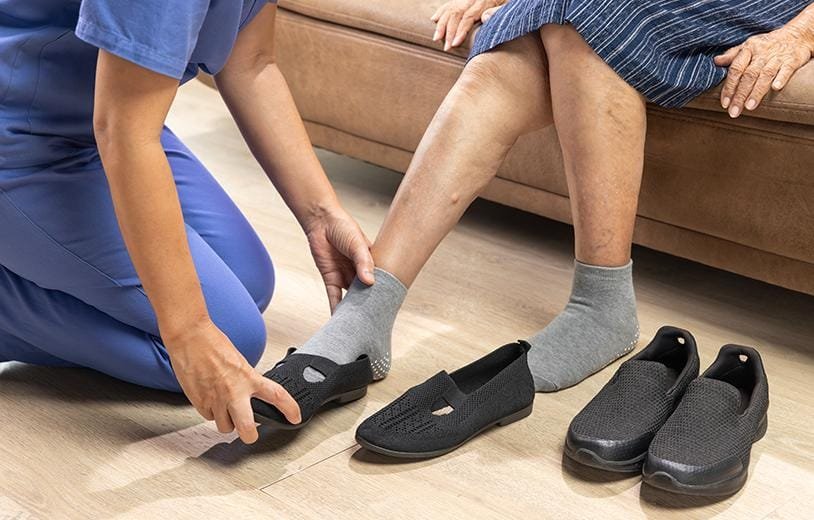
Medicated shoes can come with different closure systems.
Laces
Laces offer detailed adjustment.
Velcro
Velcro can be convenient for people who prefer quick adjustments.
Buckles
Buckles can provide adjustable fitting in certain designs.
Slip-On
Slip-on shoes can be convenient, but they should still provide a secure fit.
Which Is Best?
The best closure is the one that allows you to achieve a comfortable and secure fit.
Step 13: Check for a Removable Insole
A removable insole can be useful if you need to use another compatible insert.
For example, some people may use:
- Orthotic inserts
- Custom footbeds
- Specialized insoles
If you use a professionally recommended insert, make sure the shoe has enough internal space.
A shoe that becomes too tight after inserting an orthotic may not be suitable.
Step 14: Consider Extra-Depth Shoes
Extra-depth footwear provides additional internal space.
This may be useful for people who need room for:
- Orthotic inserts
- Certain foot shapes
- Swelling
- Deformities
- Additional cushioning
Extra depth is not necessary for everyone.
It should be selected based on your actual needs.
Step 15: Look for Comfortable Materials
The upper material affects the overall feel of the shoe.
Common materials include:
- Mesh
- Textile
- Leather
- Synthetic materials
- Combination materials
Breathable Materials
Mesh and other breathable materials may be useful for warm conditions and prolonged wear.
Softer Materials
Soft materials may feel more comfortable for sensitive feet.
However, material choice should always be considered alongside durability and structure.
Step 16: Check the Inside of the Shoe
This is an important step that many buyers skip.
Turn the shoe over and inspect the interior.
Look for:
- Rough seams
- Hard edges
- Uneven stitching
- Exposed material
- Loose components
- Areas that may rub
A smooth interior can be particularly valuable for people with sensitive feet.
Step 17: Think About Your Daily Activity
Your ideal medicated shoe depends partly on how you use it.
For Walking
Prioritize:
- Cushioning
- Stability
- Flexibility
- Traction
For Standing
Prioritize:
- Cushioning
- Stable sole
- Comfortable footbed
- Secure fit
For Travel
Prioritize:
- Lightweight construction
- Comfort
- Breathability
- Easy closure
For Work
Prioritize:
- Durability
- Appropriate traction
- Comfort
- Workplace requirements
Best Medicated Shoes for Different Foot Needs
There is no single shoe that is best for everyone.
Different needs require different features.
Medicated Shoes for Flat Feet
Consider:
- Appropriate arch support
- Stable midsole
- Comfortable cushioning
- Secure heel
- Suitable width
Avoid assuming that the highest arch support is automatically best.
Medicated Shoes for Heel Pain
Consider:
- Comfortable heel cushioning
- Stable sole
- Supportive footbed
- Appropriate arch structure
- Correct fit
Persistent heel pain should be evaluated rather than treated solely through footwear.
Medicated Shoes for Wide Feet
Look for:
- Wide toe box
- Wide-width options
- Flexible upper
- Adequate depth
Don’t simply buy a longer size to get more width.
A longer shoe may not solve a width problem.
Medicated Shoes for Sensitive Feet
Look for:
- Smooth interior
- Soft materials
- Minimal seams
- Comfortable cushioning
- No pressure points
Medicated Shoes for Diabetic Feet
People with diabetes may have different foot-care requirements depending on their individual health.
Features that may be useful include:
- Adequate toe room
- Smooth interior
- Appropriate cushioning
- Secure fit
- Suitable protection
If you have neuropathy, ulcers, deformities, or previous foot complications, professional guidance is particularly important.
How to Try Medicated Shoes Properly
If you are shopping in a store, don’t rush the fitting process.
Step 1: Wear Both Shoes
Never judge a pair using only one foot.
Step 2: Stand Up
Your feet change under body weight.
Step 3: Walk Around
Walk naturally for several minutes.
Step 4: Check the Toes
Make sure they aren’t squeezed.
Step 5: Check the Heel
Make sure it is reasonably secure.
Step 6: Check the Arch
Look for comfortable support without pressure.
Step 7: Notice Any Pressure Points
Don’t ignore discomfort during fitting.
How to Buy Medicated Shoes Online
Online shopping offers convenience, but footwear requires careful research.
Read the Size Chart
Always compare your measurements with the manufacturer’s sizing information.
Check Width Options
Look for:
- Standard
- Wide
- Extra-wide
where available.
Read the Full Description
Don’t focus only on product photos.
Check:
- Materials
- Insole
- Sole
- Cushioning
- Width
- Depth
- Closure
- Weight
Check the Return Policy
A clear exchange or return policy is especially useful for footwear.
How to Read Customer Reviews
Reviews can provide useful information, but they should be interpreted carefully.
Look for repeated comments about:
Sizing
Do many buyers say the shoe runs large or small?
Width
Do customers frequently mention a narrow or wide fit?
Comfort
Do people report comfort after extended use?
Durability
How well does the shoe hold up over time?
One person’s experience does not guarantee the same experience for you.
Price vs Quality: How Much Should You Spend?
A higher price does not automatically mean better footwear.
Likewise, inexpensive footwear is not necessarily poor quality.
Compare:
- Construction
- Materials
- Fit
- Support
- Cushioning
- Durability
- Return policy
A moderately priced shoe that fits perfectly may be a better choice than an expensive shoe that doesn’t suit your feet.
Common Mistakes When Buying Medicated Shoes
❌ Choosing Based Only on the Label
“Medicated” does not automatically mean the shoe is right for you.
❌ Buying the Wrong Size
A familiar size is not guaranteed to fit every brand.
❌ Ignoring Width
Width is just as important as length.
❌ Choosing Maximum Cushioning
More softness does not always mean better support.
❌ Ignoring the Interior
Rough seams can cause irritation.
❌ Buying Shoes That Hurt During Fitting
Don’t expect significant discomfort to disappear automatically.
❌ Buying Only for Appearance
Style matters, but fit and comfort should come first when you have special footwear needs.
How to Break In New Medicated Shoes
Even comfortable shoes can feel unfamiliar at first.
If you have sensitive or high-risk feet, introduce new footwear gradually.
Start With Short Periods
Wear them for a limited time initially.
Then inspect your feet.
Look for:
- Redness
- Blisters
- Rubbing
- Pressure marks
- Skin irritation
If problems repeatedly appear, reassess the fit.
How to Maintain Your Medicated Shoes
Good maintenance can help extend the useful life of your footwear.
🧼 Clean Them Properly
Follow the manufacturer’s cleaning instructions.
🌬️ Let Them Dry
Don’t store damp shoes in closed spaces.
🔍 Inspect the Interior
Look for worn lining or rough areas.
👟 Check the Outsole
Look for uneven wear and reduced traction.
🧩 Check the Insole
Replace worn or damaged inserts when appropriate.
When Should You Replace Your Shoes?
Shoes should be replaced when they are no longer providing appropriate comfort, support, or stability.
Look for:
- 🛑 Flattened cushioning
- 🛑 Uneven sole wear
- 🛑 Cracked outsole
- 🛑 Damaged heel
- 🛑 Torn upper
- 🛑 Loss of structural support
- 🛑 New pressure points
Don’t judge shoe condition solely by appearance.
A shoe can look fine externally while the cushioning has already deteriorated.
Signs You Should Reconsider Your Footwear
If you consistently notice:
- ❌ Foot pain
- ❌ Heel pain
- ❌ Toe pressure
- ❌ Blisters
- ❌ Rubbing
- ❌ Numbness
- ❌ Excessive heel movement
- ❌ Instability
your footwear may not be suitable.
However, persistent symptoms should not automatically be blamed on shoes.
When Should You Seek Professional Advice?
Some foot problems require more than a footwear change.
Consider professional evaluation if you experience:
- ⚠️ Persistent pain
- ⚠️ Severe discomfort
- ⚠️ Sudden swelling
- ⚠️ Numbness or tingling
- ⚠️ Difficulty walking
- ⚠️ A significant change in foot shape
- ⚠️ A wound
- ⚠️ Symptoms after an injury
People with diabetes or other conditions associated with increased foot risk should be particularly attentive to changes in their feet.
Frequently Asked Questions
What are the best medicated shoes?
There is no single best medicated shoe for everyone. The right choice depends on your foot shape, activity, comfort requirements, and any specific foot condition.
How do I know if medicated shoes fit correctly?
Your toes should have enough room, the heel should remain reasonably secure, and the shoe should not create pressure or rubbing.
Should medicated shoes be tight?
No. Supportive footwear should feel secure but should not squeeze your feet.
Are wide medicated shoes better?
They are better when your feet require additional width. Choose the width that matches your foot rather than automatically choosing the widest option.
Do medicated shoes help with foot pain?
Supportive footwear may improve comfort for some people, but foot pain can have many causes. Persistent pain should be professionally evaluated.
Are medicated shoes good for standing all day?
Shoes with appropriate cushioning, stability, support, and fit may be more comfortable during prolonged standing.
Can I use custom orthotics in medicated shoes?
Some medicated shoes have removable insoles and enough internal space for compatible orthotics. If you use a prescribed orthotic, make sure the shoe can accommodate it correctly.
How often should I replace medicated shoes?
Replace them when cushioning, structure, traction, or fit has deteriorated. The exact lifespan depends on how often and how intensely they are used.
Can I buy medicated shoes online?
Yes. Check the size chart, width, materials, product specifications, reviews, and return policy before purchasing.
Are expensive medicated shoes always better?
No. Price does not guarantee that a shoe will fit your feet correctly or provide the support you need.
Final Checklist Before Buying Medicated Shoes
Before completing your purchase, ask yourself:
👣 Fit
- Does the shoe fit both feet comfortably?
- Is there enough toe room?
- Is the width appropriate?
🦶 Support
- Does the footbed feel comfortable?
- Is the arch support appropriate?
- Does the heel feel secure?
🛋️ Comfort
- Is the cushioning comfortable?
- Are there any pressure points?
- Does the shoe feel good while walking?
🛡️ Construction
- Is the outsole stable?
- Is the traction appropriate?
- Are the interior seams comfortable?
🔄 Practicality
- Is the closure easy to use?
- Can the shoe accommodate your insert if needed?
- Is it suitable for your daily activities?
🛒 Purchase
- Did you check the size chart?
- Did you check the return policy?
- Did you compare customer reviews?
If the answer to these questions is yes, you are in a much better position to make an informed purchase.
Final Thoughts
Choosing the right medicated shoes is not simply about finding a shoe with the right label.
The most important factors are fit, comfort, support, stability, cushioning, and suitability for your individual needs.
Before buying, consider your foot shape and the activities you perform every day. Pay attention to width as well as length, check the toe box, examine the interior, and make sure the heel remains secure.
If you use orthotic inserts, look for shoes with sufficient depth and removable insoles when appropriate.
For people with specific conditions such as diabetes-related foot problems, significant deformities, persistent pain, or reduced sensation, professional advice can be especially valuable.
Remember that the most expensive or heavily marketed shoe is not necessarily the best one.
The right medicated shoe is the one that fits your feet properly, provides appropriate support, feels comfortable during movement, and meets the demands of your everyday life.
Good footwear is an investment in everyday comfort—and choosing it carefully can make every step feel better.